

Beyond the Acronyms: Why Safety Credentials Are Only Part of the Story
Why credentials matter, but management control matters more

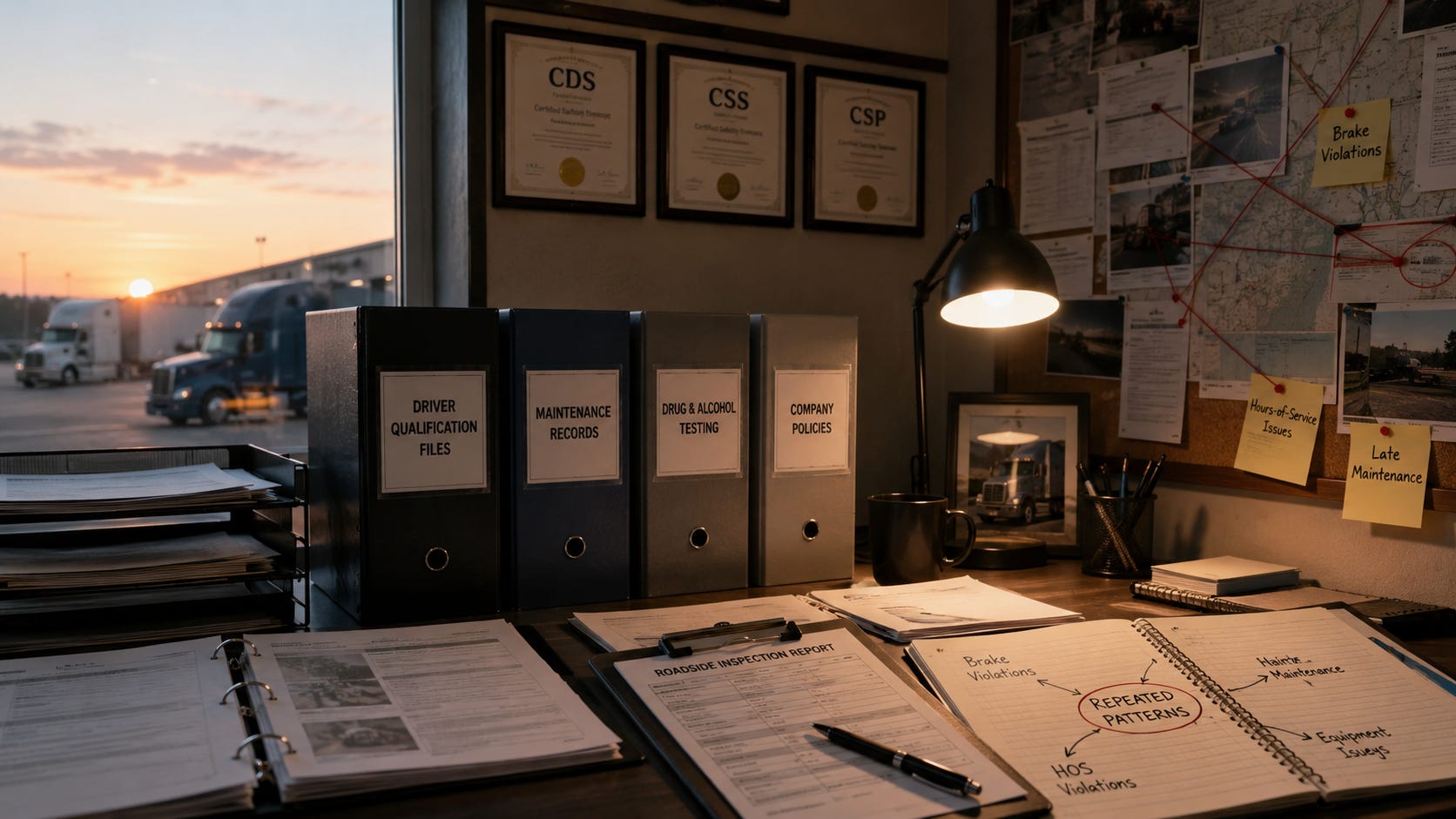
Credentials Matter. But They Are Not the Same as an Investigator’s Lens.
Walk into a solid motor carrier operation and you might see safety folks with letters after their names.
CDS. CSS. CSP. Maybe a few others.
Those letters matter.
They usually represent time, training, experience, coursework, and a real commitment to the profession. I am not here to knock credentials. A strong safety director can be one of the most valuable people in the building.
They help keep driver files from turning into mystery novels. They keep drug and alcohol testing programs on track. They watch maintenance records, policies, inspections, annual reviews, renewals, and all the other details that can get sideways in a hurry.
A carrier with a capable safety person is already ahead of a lot of operations.
But there is a trap here.
A safety credential does not automatically mean the carrier is ready for how an FMCSA investigation, compliance review, serious crash review, insurance evaluation, or plaintiff’s attorney inquiry may actually unfold.
That is not an insult.
It is just a different way of looking at the same operation.
One skill set is about managing the program.
Another skill set is about understanding what the records, violations, trends, and decisions may say when somebody outside the company starts connecting the dots.
And those dots matter.
Good compliance work creates order
A good safety professional brings order to a place that can get messy fast.
Trucking is not a quiet business. Trucks break. Drivers call in. Loads move. Dispatch needs answers. Maintenance has priorities. Somebody is always looking for a missing document, a renewal date, a test result, or a file that was definitely “right there yesterday.”
Good safety work keeps the operation from drifting.
It gives the company structure. It keeps files current. It keeps policies from getting stale. It helps drivers understand expectations. It gives management something to work from instead of guessing.
That work is not minor.
Without it, the cracks start showing.
Driver qualification files get thin. Annual reviews get missed. Maintenance records become inconsistent. Drug and alcohol testing gaps appear. Roadside violations repeat because nobody is watching the pattern. Policies sit in a folder, but nobody is quite sure if they still match how the company actually runs.
So yes, credentials matter. Safety administration matters. Organized files matter.
But a clean-looking file cabinet does not always mean the carrier is ready for a deeper review.
The question is not just whether the paperwork exists
A lot of carriers think compliance is mostly about whether the document is there.
Is the form in the file?
Is the policy written?
Is the maintenance record saved?
Is the test result documented?
Those are fair questions. They matter.
But they are not the only questions.
In a real review, the bigger question is usually whether the paperwork matches the operation.
Does the driver file match the driver’s actual history?
Do the maintenance records line up with what roadside inspections are showing?
Do the ELD records make sense when compared to supporting documents?
Does the written policy match what people actually do when the day gets busy?
Are the violations isolated mistakes, or do they point to a management problem?
That is where the risk starts to change shape.
A missing document is one thing.
A pattern that nobody noticed, nobody owned, and nobody corrected is something else.
Reviewers are looking for control
In an investigation or review, nobody expects perfection.
At least, that is not how I would look at it.
Carriers are made up of human beings, equipment, schedules, weather, customers, drivers, shops, terminals, and a lot of moving parts. Things happen. Documents get missed. Mistakes show up. A roadside inspection may not go the way anybody wanted.
The question is not whether the carrier had a bad day.
The question is whether the carrier had control of its operation.
When a violation showed up, did anyone know?
When the same issue showed up again, did anyone respond?
When a driver developed a pattern, did management step in?
When maintenance defects kept appearing roadside, did anyone look at the shop process?
When documents did not match, did the company catch it internally, or did someone outside the company have to find it first?
That is the part carriers sometimes miss.
The issue is not always the violation by itself.
The issue is what the violation says about the system behind it.
Two carriers can have the same violation on paper and look very different in a review.
One carrier may be able to show what happened, who reviewed it, what was done, and how they tried to keep it from continuing.
Another carrier may have the same issue scattered across drivers, trucks, locations, and months with no real response.
Same violation.
Very different story.
The gaps between systems are where things get interesting
Most serious compliance problems do not start with one big dramatic failure.
They usually start in the gaps.
The ELD system says one thing.
The fuel receipt suggests something else.
The driver file is technically there, but it is missing enough pieces to raise questions.
The maintenance record exists, but it does not explain why the same defects keep showing up roadside.
The policy sounds fine, but the operation has been doing something different for months.
The roadside history shows a trend, but nobody inside the company seems to have noticed it.
That is where investigation readiness comes in.
A carrier does not need to be scared of its own data. But it does need to understand what that data may be saying.
Because if the carrier does not connect the dots first, someone else may.
That someone could be an investigator. It could be an insurer. It could be a broker. It could be an attorney after a crash.
And by that point, the pattern may already be sitting there.
Checklist compliance has limits
There is a version of compliance work that treats everything like a binder problem.
Get the form.
Fill the folder.
Check the box.
Move on.
That may help with organization. Sometimes that is exactly where a carrier needs to start.
But a checklist can only take you so far.
A checklist can tell you whether a file exists. It may not tell you whether the file creates exposure.
A checklist can confirm that a maintenance record is present. It may not tell you whether roadside inspections are pointing to a bigger maintenance issue.
A checklist can show that a driver qualification file has documents in it. It may not tell you whether the hiring decision itself would raise questions later.
A checklist can show that a policy was written. It may not show whether the company actually followed it.
That is the difference between having paperwork and understanding what the paperwork says.
And sometimes the paperwork talks more than people realize.
This is not an argument against credentials
I want to be clear about that.
This is not me saying safety certifications do not matter.
They do.
The best safety professionals I know are always learning. They take the job seriously. They understand that compliance is not just a file cabinet. It is part of how the company manages risk every day.
But carriers should not assume the letters after someone’s name automatically cover every angle.
A strong safety program usually needs a few things working together.
It needs operational knowledge. Somebody has to understand how the company actually runs, not just how the policy says it runs.
It needs compliance structure. Files, testing, maintenance, inspections, renewals, policies, and records all need attention.
And it needs an investigator’s lens. Somebody needs to be able to look at the same records and ask, “What would this look like to someone outside the company?”
That third piece is often the missing one.
Not because people do not care.
Usually because they are busy keeping the machine running.
Better questions lead to better answers
The basic question is:
“Do we have the required documents?”
That question still matters.
But it should not be the only question.
A better set of questions sounds more like this:
Do our records match how we actually operate?
Are we catching repeated violations before someone outside the company catches them?
Can we explain what happened, what we did about it, and what changed afterward?
Are our safety systems producing evidence that management is paying attention?
Would our own data tell a story we are comfortable explaining later?
Those questions move the conversation past basic compliance.
They get closer to real risk management.
And no, that does not mean every carrier needs to live in fear of an audit, investigation, lawsuit, or insurance review. That is no way to run a business.
But it does mean carriers should be honest about what their records may show.
The bottom line
A good safety director is a major asset.
A well-organized compliance program matters.
Industry credentials matter.
But when a carrier is under review, the question is not simply whether someone completed a course, built a binder, or checked the required boxes.
The question is whether the company can show that it understands its risks, watches its operation, responds to problems, and maintains control over the patterns that matter.
That is where an investigator’s lens becomes useful.
Because in a real review, the issue is rarely just one missing document or one bad inspection.
The bigger issue is what the total record says about the carrier.
And by the time someone outside the company is asking those questions, the story may already be written.