

Before the Rear-End Crash: 4 Warning Signs Carriers Should Not Ignore

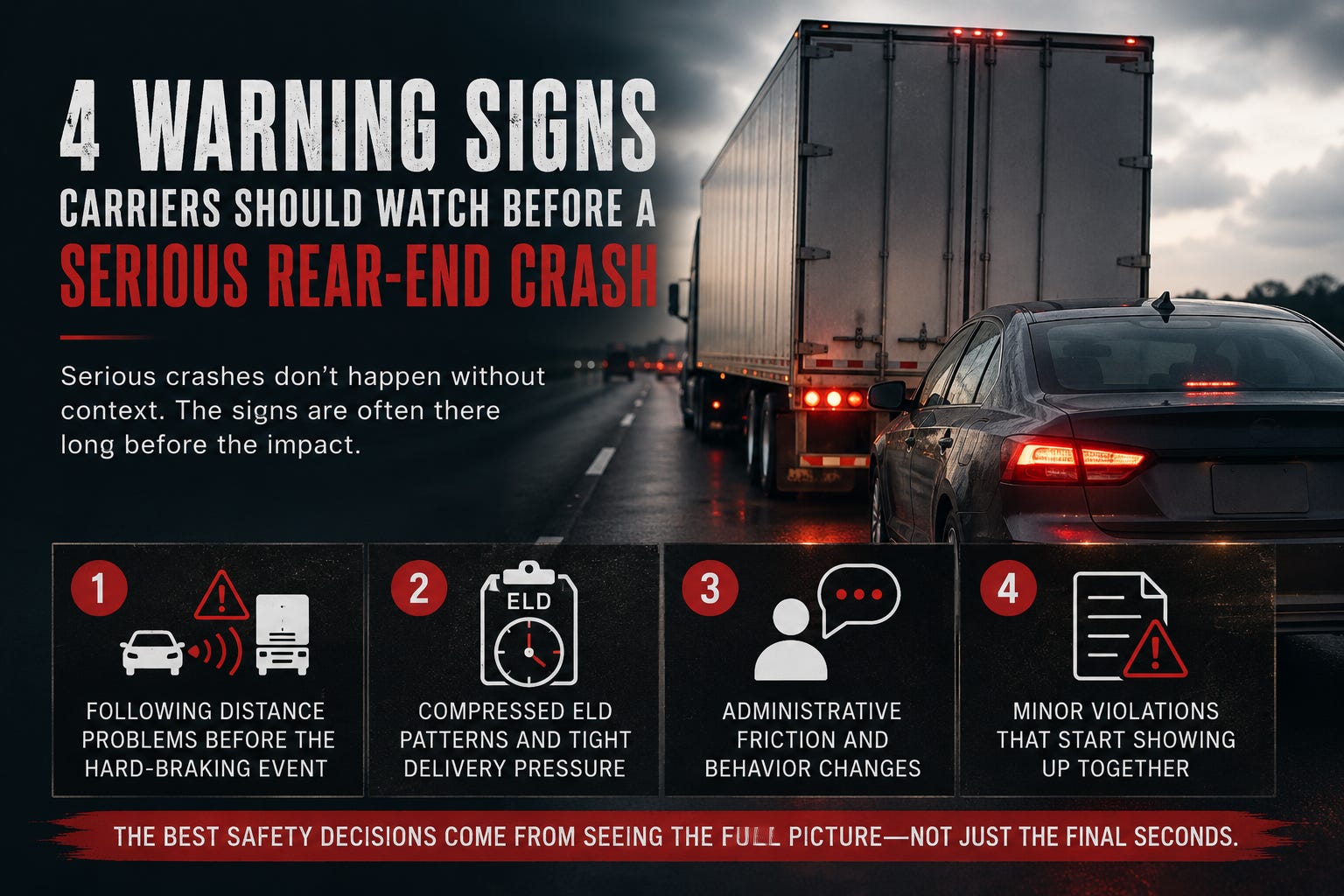
Before the Rear-End Crash, the Records May Already Be Talking
A serious rear-end crash can look like it came out of nowhere.
Traffic is moving until it is not. A driver has only a few seconds to recognize what changed, decide what to do, and make the truck respond. In that moment, everything gets tight. Space disappears. Reaction time disappears. The road does not care how good the paperwork looked the day before.
After a serious crash, the questions usually move straight to those final seconds. Was the driver tired? Was the driver following too close? Was speed part of it? Was there a distraction? Could the driver have done something different?
Those are fair questions. The last few seconds matter. But they may not be where the story started.
Sometimes the better question is what the carrier’s own records were already showing before the crash. That is where these situations can get uncomfortable. A crash may look sudden on the road, but when someone starts working backward through the records, it may not look quite as sudden anymore.
The telematics may have been showing close-following alerts. The ELD may have been showing drivers running deep into their available hours. Dispatch messages may have shown schedule pressure. Coaching notes may have shown the same behavior coming back. Roadside inspections may have pointed to a pattern. Internal alerts may have been sitting in a dashboard everyone assumed someone else was watching.
The problem is not always that the carrier had no information. Sometimes the information was there, but it lived in five different places and nobody slowed down long enough to put the pieces beside each other.
That is why rear-end risk is worth studying before there is a crash, not just after. It often involves space, attention, speed, fatigue, pressure, or some combination of all of those. Those issues do not always appear out of thin air. A lot of times, they leave tracks first. Not always, but often enough that carriers should be looking.
One of the first places I would look is following distance. A lot of carriers wait for the big hard-braking event before they really pay attention. The camera clip comes in, the alert gets flagged, and suddenly everyone wants to talk about what happened.
By then, the warning signs may have already been building. Maybe there were close-following alerts before that. Maybe there were forward-collision warnings. Maybe there were moderate braking events, lane alerts, or near misses in congested areas.
One alert by itself may not tell much of a story. Drivers operate in the real world. Cars cut off trucks. Traffic stacks up. Weather changes. Construction zones appear with little warning. Anyone who has spent time around trucking knows you cannot treat every alert like a full confession.
But when those alerts start showing up more often, that deserves a closer look.
It may mean the driver’s space cushion is shrinking. And that matters because following distance is one of the simplest safety margins a driver has. When that space disappears, everything else gets tighter. There is less time to respond, less room to brake, and less room for traffic, weather, construction, sudden stops, or somebody in a small car making a bad decision two vehicle lengths ahead.
So I would not only ask whether the driver had a hard-braking event. I would ask whether the driver was already showing a pattern of reduced space management before that hard brake ever happened.
That is a different question, and it is usually a better one.
The same kind of thinking applies to the ELD.
Hours-of-service compliance matters, but being legal does not automatically mean the trip was well planned or that the driver had enough room for the real world. A driver can be technically legal and still be running with almost no margin.
That can mean no room for traffic, weather, detention, parking, a slow shipper, a bad route, a missed turn, or the driver just needing a few minutes to breathe. On paper, the trip may work. In real life, it may be held together with stress, luck, and a clock that keeps getting louder.
That is where I would want to look beyond the log itself. I would want to look at the appointment time and whether it made sense. I would look at the route and whether it gave the driver breathing room. I would look at detention, parking, dispatch expectations, and how much time was left when the driver got back on the road. I would look at whether this was one bad day or whether the same lane keeps putting drivers in the same tight spot.
That is not about blaming dispatch. Dispatch lives in the middle of the storm most days. A dispatcher may be trying to keep customers calm, keep drivers moving, find equipment, work around delays, and solve five problems before lunch. Most pressure in trucking is not created by one bad person making one bad decision. A lot of it builds quietly through expectations, appointment times, customer demands, detention, parking problems, and the normal strain of trying to keep freight moving.
But pressure can still be created even when nobody is trying to create it.
A driver trying to make a delivery window, stay legal, find parking, answer dispatch, manage detention, and keep the customer happy may start narrowing focus. That does not mean the driver is trying to take risks. It does not mean the dispatcher is trying to create risk. It means the margin is getting thin.
And when the margin gets thin, small problems get bigger.
That is why the question cannot only be, “Was the driver legal?” Sometimes the better question is, “Did the way this trip was planned leave enough room for the real world?”
There is another warning sign that can be easy to miss because it does not look like a crash issue at first. It just looks like friction.
A driver gets harder to reach during routine safety follow-up. Dispatch messages get shorter or sharper. Coaching conversations start creating unusual pushback. Log corrections become more frequent. Small problems start showing up in different systems.
None of that may seem dramatic in the moment. The log issue gets handled. The message gets ignored. The coaching note goes into the file. The driver’s attitude gets chalked up to a bad week. Everyone moves on because the day is busy and nothing looks big enough to stop over.
And maybe that is all it is. Drivers have bad weeks. So do safety managers, dispatchers, mechanics, and everyone else who works with a phone that never stops making noise.
But sometimes small changes are telling the company something. Maybe the driver is tired. Maybe they are burned out. Maybe they are frustrated with the schedule. Maybe something changed at home. Maybe the route changed. Maybe the truck changed. Maybe the driver is mentally overloaded and it is starting to show up in places that look unrelated.
The point is not to assume the worst. The point is to notice when something changes.
If a driver has always been steady and suddenly starts showing small problems across different areas, someone should be willing to ask a real question before jumping straight to discipline. Something as simple as, “What changed?”
Not as a trap. Not as a lecture. Just a real question.
What changed with the route? What changed with dispatch? What changed with the truck? What changed with the schedule? What changed in the driver’s day that may be showing up in the records?
That conversation may tell the carrier more than another dashboard alert. It may also give the company a chance to step in before the problem gets worse.
The other thing I would watch closely is when minor issues start showing up together. One small speeding event may have an explanation. So may one lane departure warning, one log correction, one close-following alert, one roadside issue, one missed appointment, or one coaching note.
But when those little things start clustering around the same driver, truck, route, terminal, customer, or dispatch lane, the carrier should pay attention. That may be where the pattern is hiding.
This is also where companies can fool themselves. The log issue gets reviewed by one person. The speeding alert sits in the telematics system. The dispatch complaint stays with operations. The roadside inspection goes into the file. The coaching note gets saved somewhere else. The ELD correction gets handled by whoever handles ELD.
Everybody touches their own piece, but nobody sees the whole picture.
Then a serious crash happens, and all of those separate records are sitting on the same table for the first time. That is a bad time to discover the pattern.
After a rear-end crash, the fact that the alerts lived in different systems may not matter much. The question may become what the company knew, when it knew it, and what it did with that information.
That is why carriers need to get better at connecting records before someone else connects them later.
When warning signs do show up together, the answer is not always punishment. Sometimes discipline is appropriate. I am not saying it never is. But if the whole response is “driver coached,” the company may miss the bigger issue.
A better first step may be a real conversation tied to the actual information.
“We are seeing more close-following and hard-braking alerts over the last couple of weeks, especially near the end of your driving day. We also see several tight delivery windows on this lane. Is the schedule creating pressure that is affecting how you are driving?”
That is a very different conversation than, “You need to drive better.”
The first conversation looks at the driver and the system. The second one just blames the driver and moves on.
Carriers need to know the difference.
Sometimes the issue really is individual behavior. Sometimes the issue is operational pressure. A lot of times, it may be both. The job is to figure that out early enough to do something useful.
That does not require a complicated new program. It can start pretty simply. Pick one driver, one truck, one route, or one dispatch lane that has been showing recent warning signs. Then look back over the last 30 days and put the story in order.
If there was a hard-braking event, what happened before it? Were there close-following alerts? Was the driver running deep into available hours? Were there tight delivery windows? Was there detention? Were dispatch messages getting tense? Was this the same lane where other drivers were also having trouble?
That is the value of building a simple timeline. It changes the conversation.
One hard-braking event may look like a driver issue by itself. But if it came after two weeks of tight schedules, last-hour driving, frustrated messages, and repeated close-following alerts, then the story looks different.
I would also compare the driver to their own normal pattern, not just the fleet average. Fleet averages can be useful, but they can also hide change. A driver who has been steady for years and suddenly starts having more alerts may be telling you something.
Maybe hard-braking events are increasing on a certain lane. Maybe communication has changed. Maybe log corrections are happening more often. Maybe the driver is running deeper into available hours than usual. Maybe the change started after a new customer, a new route, a new dispatcher, a new truck, a new schedule, or a new delivery expectation.
That matters because a driver who suddenly changes may need a different response than a driver who has always had the same issue. Both may need attention, but they are not necessarily the same problem.
Once the pattern is visible, the carrier needs to separate behavior from pressure as best it can.
If one driver has close-following alerts across different lanes, different customers, different times of day, and different dispatchers, that may point more toward driver behavior. If several drivers start having the same alerts on the same lane, under the same customer, around the same delivery window, that may point more toward operational pressure. If the issues show up near the end of available hours, after detention, during parking pressure, or after repeated long days, fatigue needs to be part of the conversation.
The company does not have to solve the entire thing in one sitting. But it should be able to show that it looked beyond the easiest answer.
Then the response needs to match what the records showed.
If the pattern is following distance, address space management and watch whether the pattern improves. If the pattern is schedule compression, look at appointment times, routing, detention, parking, and dispatch expectations. If fatigue is part of it, look at timing, workload, rest opportunity, and whether the driver is constantly operating at the edge of available hours. If communication is breaking down, talk with the driver and the people around that driver. Not just safety. Dispatch too. Maybe maintenance. Maybe driver management. Whoever is close enough to understand the pressure around that situation.
And if the same pattern is showing up across several drivers on the same lane or customer account, do not stop with one driver.
That is where a generic note that says “driver coached” may not be enough. It may be true. It may even be appropriate. But it may not answer the better question.
Did the response match the risk the carrier’s own information showed?
A review is not complete just because somebody noticed the pattern. The carrier still needs to close the loop.
What did we see? When did we see it? Who reviewed it? What did the driver say? Was dispatch, routing, scheduling, detention, parking, or customer pressure part of the issue? What action did we take? Who was responsible for follow-up? Did the pattern improve, or did it come back again?
That does not need to become a giant program. It does not need a fancy name. It does not need a color-coded binder that ruins somebody’s afternoon.
But if the company identifies a warning pattern and never follows up, the risk has not really changed. It has just been observed.
There is a difference between seeing something and managing it.
A stronger file does not just say, “Driver coached.” A stronger file tells the story in a way someone else can understand later. It shows that the carrier identified a pattern, reviewed it in context, talked to the driver, considered whether the issue was driver behavior, operational pressure, or both, took action tied to the risk, and followed up to see whether the pattern changed.
That is the difference between having data and using it.
A rear-end crash may happen in seconds, but the risk pattern may have been developing for weeks. The warning signs may have already been sitting in the carrier’s own systems: telematics alerts, ELD patterns, dispatch pressure, driver behavior changes, minor violations, roadside data, and internal communication.
Good safety work does not wait for a crash, insurance review, lawsuit, or investigation to connect those dots. It looks for the pattern early. It has the hard conversation while there is still time for it to matter. And it documents what happened next.
Because after a serious rear-end crash, the question may not only be, “What did the driver do wrong?”
It may also be, “What did the carrier know, and what did it do with that information?”
That is the question worth asking before the crash.
Not after.