

The Driver Immunity Myth
Can FMCSA Fine a Driver Personally?

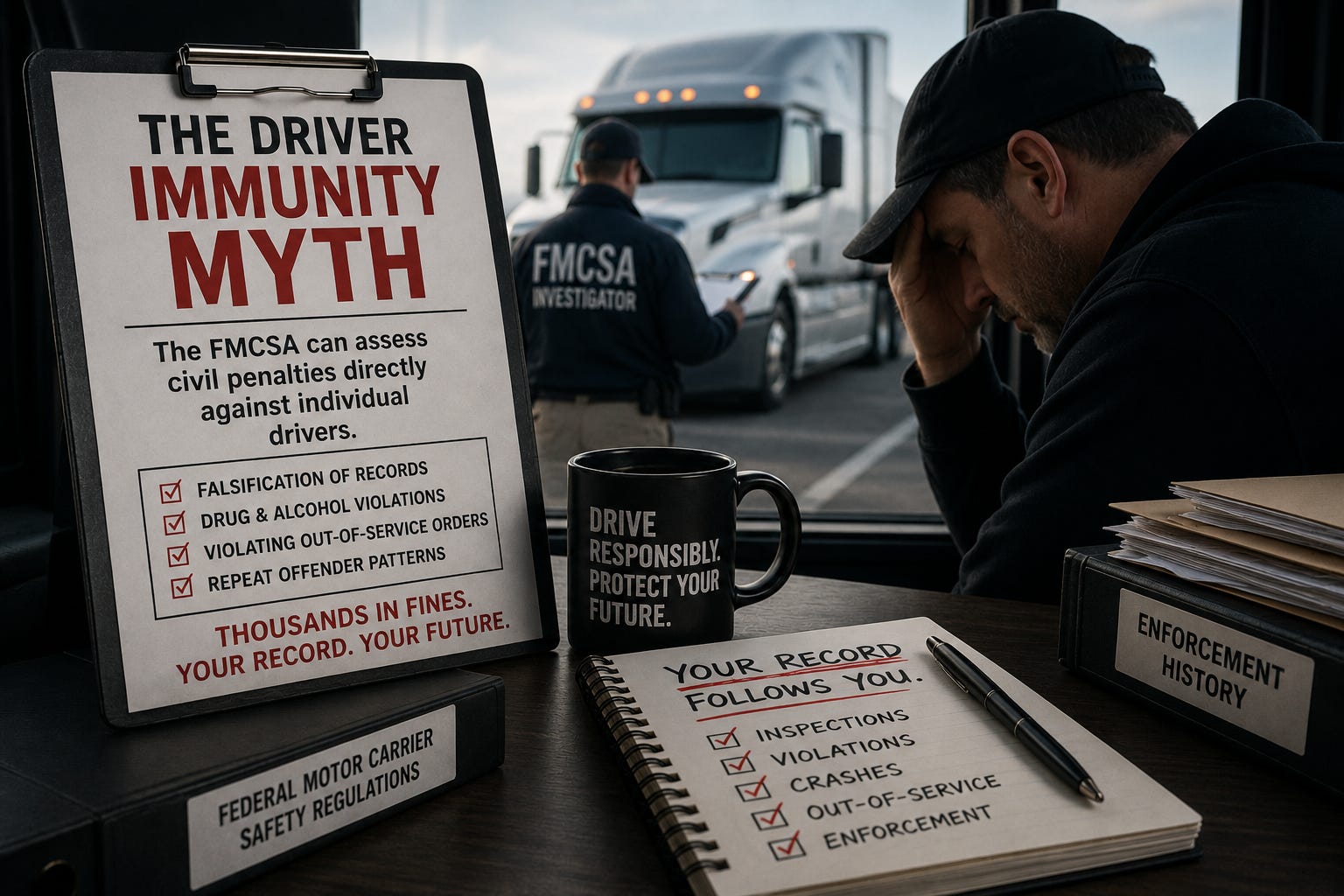
Ask most company drivers or owner-operators if FMCSA can fine them personally, and you will usually hear the same answer.
“No. The company gets fined. I only have to worry about traffic tickets.”
That belief is common in trucking.
It is also wrong.
Many drivers assume federal enforcement stops with the motor carrier. They believe the company’s DOT number absorbs the federal consequences, while the driver only deals with traffic tickets, roadside paperwork, and maybe a local court date.
That is not always how it works.
FMCSA has authority to assess civil penalties directly against individual commercial drivers for certain violations of the Federal Motor Carrier Safety Regulations. Federal investigators are not limited to pursuing the motor carrier every time.
In the right circumstances, an individual driver can become the focus of enforcement.
And depending on the violation, the penalty can reach thousands of dollars.
Why drivers believe the myth
Most drivers only see one part of the enforcement system.
A roadside inspector conducts an inspection. A violation is discovered. Paperwork gets issued. The driver leaves. The carrier handles the fallout.
Because that is the experience most drivers see, they naturally assume the carrier absorbs all federal consequences.
But roadside inspections are only one piece of a larger system.
Behind every inspection is a trail of records: inspections, violations, crashes, out-of-service orders, enforcement history, and safety data. Investigators are not just looking at a single piece of paper from one stop. They are often looking at patterns over time.
Sometimes those patterns point to a company problem.
Sometimes they point to a driver problem.
Often, they point to both.
Traffic tickets and federal enforcement are not the same thing
A speeding ticket and a federal enforcement action are not the same thing.
Traffic citations are generally handled through local or state courts. Federal enforcement actions come from alleged violations of federal safety regulations.
That difference matters.
A local ticket may involve one event on one road in one jurisdiction. A federal enforcement case may involve a broader review of records, conduct, history, and whether the driver or carrier violated the FMCSRs.
A driver does not need to think like a lawyer to understand the practical point:
The ticket is not always the whole problem.
A local citation may be one issue. A federal regulatory violation may be another.
Violations that can create personal exposure
Not every violation results in direct enforcement against the driver. Many violations are handled through the carrier. Some are corrected at roadside. Some become part of the carrier’s safety record without turning into a personal enforcement case.
But there are certain categories where drivers should understand the risk.
False records
Hours-of-service records remain one of the most heavily scrutinized areas of transportation enforcement.
That can include false log entries, running under another driver’s account, using ghost logs, altering records to hide driving time, manipulating ELD information, or certifying records the driver knows are not accurate.
Some drivers think of log problems as paperwork problems.
Investigators usually see them differently.
Hours-of-service rules are tied to fatigue risk. When records are intentionally falsified, the issue is not just a bad form or a missed entry. It can look like an attempt to defeat the safety system that is supposed to show when a driver was working, driving, resting, or available.
That does not mean every log mistake is treated the same way. A missed edit, a training issue, a device problem, or confusion over a duty status is different from intentional falsification.
But once the facts suggest the record was knowingly changed, hidden, or misrepresented, the risk changes.
Drug and alcohol violations
Drug and alcohol violations carry serious consequences in trucking, and they can create exposure for both the driver and the carrier.
Examples include refusing a required drug or alcohol test, operating while prohibited from safety-sensitive functions, failing to complete return-to-duty requirements before returning to covered work, or operating after a disqualifying drug or alcohol event.
Some drivers assume there must be a criminal charge before federal action can occur.
That is not the case.
A criminal case and a federal regulatory matter are different things. The absence of a criminal conviction does not automatically mean there is no federal enforcement risk.
That point surprises a lot of drivers because they tend to think in terms of tickets, court dates, and criminal charges. FMCSA enforcement is about regulatory compliance. The question is not only whether a prosecutor filed a case. The question is whether the driver’s conduct violated the federal safety rules.
Violating an out-of-service order
Ignoring an out-of-service order is one of the fastest ways for a driver to make a bad situation worse.
When an inspector places a driver out of service, the instruction is not complicated:
Do not operate until the order is satisfied.
Out-of-service orders are issued because an immediate safety concern exists. The reason may involve hours of service, medical qualification, drug or alcohol disqualification, or another serious issue identified during enforcement activity.
A driver who moves the truck anyway is not just dealing with the original violation anymore. The decision to ignore the order can become its own serious problem.
From an investigator’s perspective, that matters because the driver was directly told not to operate and chose to operate anyway.
The repeat-offender problem
This is where many drivers misunderstand how federal enforcement really works.
Most people think every violation starts with a clean slate.
It does not.
Inspection and crash information can follow a driver in ways that matter. A driver’s PSP record, for example, includes several years of crash and roadside inspection history. Carriers may review that information during hiring, and investigators may review records during enforcement activity.
That does not mean every past violation follows a driver forever. It does mean a driver should not assume each inspection exists in isolation.
A single hours-of-service violation after years of clean inspections may look one way.
Multiple hours-of-service violations, repeated log discrepancies, and several out-of-service orders over time may look very different.
Both drivers may have violated the rules. But investigators are not likely to view those situations the same way.
One may look like a mistake, a training issue, or an isolated event.
The other may look like a pattern.
And patterns attract attention.
How investigators tend to look at it
One of the biggest misconceptions in trucking is that investigators only care about the latest inspection.
That is not usually how the system works.
FMCSA’s safety enforcement system is built around data, patterns, risk, and interventions. Investigators look for where the safety problem is coming from and what needs to change.
That means they may ask questions like:
Is this an isolated event?
Is this happening repeatedly?
Does the conduct appear intentional?
Did the carrier create pressure that contributed to the violation?
Did dispatch, training, supervision, maintenance, or scheduling play a role?
Is the driver the common factor across multiple events?
Is the carrier ignoring a known issue?
Is the behavior creating ongoing safety risk?
Those questions matter because they affect where the attention goes.
A driver may be part of a larger carrier problem. A carrier may have weak systems, poor training, unrealistic dispatch expectations, bad communication, or a culture that quietly rewards noncompliance.
But there are also cases where the facts point back to the individual driver.
That is when personal exposure becomes more than a theory.
Why this matters to drivers
A lot of drivers focus on what happens at the scale house.
Experienced investigators look at what happens over time.
That is the part drivers need to understand.
A roadside inspection may feel like a one-day event. But the record created that day can become part of a larger picture. If the same kinds of violations keep showing up, especially across different inspections or different carriers, the picture starts to tell a story.
That story may be fair.
It may be incomplete.
It may need context.
But it still exists in the records.
And in trucking, records matter.
This is why drivers should take inspection reports, log edits, out-of-service orders, drug and alcohol requirements, and documentation seriously. Not out of fear. Not because every violation turns into a federal case. But because patterns are easier to explain when the records are clean, accurate, and addressed early.
The bottom line
The belief that only motor carriers face FMCSA penalties is one of the most persistent myths in trucking.
Motor carriers absolutely face enforcement.
But drivers are not immune.
FMCSA can assess civil penalties against individual drivers when the facts and regulations support it. That does not happen in every case, and it does not mean every roadside violation becomes a personal enforcement action.
But the authority exists.
For company drivers and owner-operators, the lesson is simple: do not treat federal safety violations like they are always somebody else’s problem.
By the time an investigator starts looking at a driver individually, the issue is usually larger than one bad inspection.
It is usually about conduct, records, and patterns.
And those are worth paying attention to before someone else does.