

What Unassigned Driving Time Says About ELD Control
Why unassigned driving time can reveal more than a clean log ever will

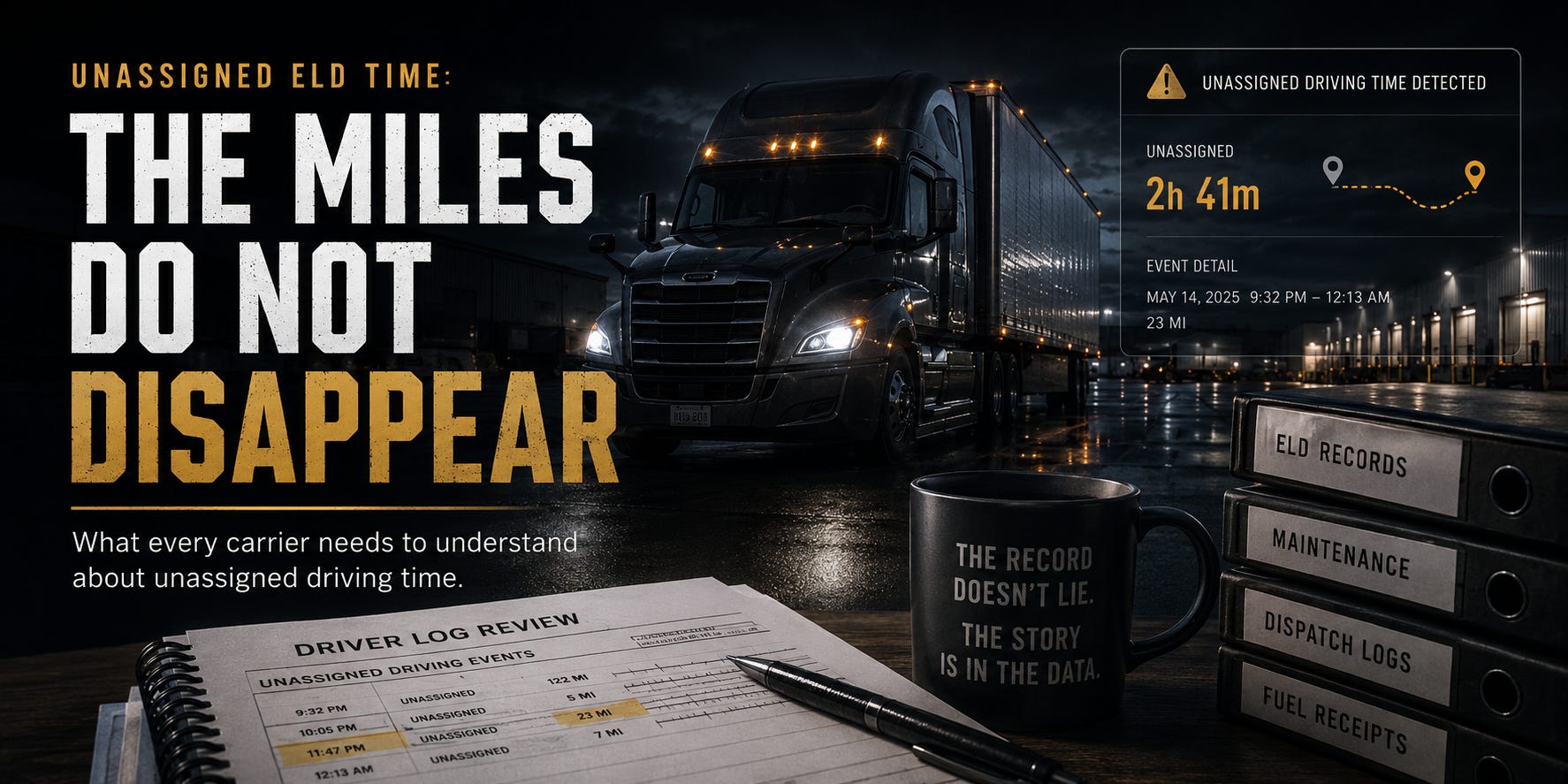
What Unassigned Driving Time Says About ELD Control
If you want to know where some hours-of-service problems may be hiding, I would not start with the cleanest driver log in the file.
I would start with the driving time nobody claimed.
That is where the operation may start telling on itself.
Unassigned driving time is easy to brush off when it shows up in small pieces. A truck moves across the yard. A driver forgets to log in before repositioning a unit. A mechanic moves a truck out of the bay. A system event creates confusion. A driver rejects time that really does not belong to them.
None of that automatically means the carrier has a serious problem.
But when unassigned driving time keeps piling up, the question changes. It is no longer just, “Who drove the truck?”
The better question becomes, “Why does this carrier not have better control over its own driving records?”
That is the part a lot of companies miss.
Unassigned driving time is not just ELD housekeeping. It can be a window into driver habits, shop movement, yard procedures, dispatch pressure, weak back-office review, and sometimes driving time that nobody wants to claim.
The rule itself is not complicated.
When a driver logs in and the ELD prompts them about unassigned driving time, the driver has to review it. If the time belongs to that driver, the driver has to add it to their own record. If it does not belong to that driver, the driver has to indicate that in the ELD record.
The carrier has work to do too. The carrier has to review unidentified driving records and either assign the time to the right driver or annotate the record and explain why the time is unassigned. The carrier also has to retain those unidentified driving records as part of its hours-of-service ELD records and be able to provide them when authorized safety officials ask.
That sounds clean enough on paper.
Driver reviews it. Carrier assigns it or explains it. Record is retained.
Real life is where it gets messy.
Because the ELD does not just create a record. It creates a question.
And if the carrier does not answer that question before an audit, investigation, claim, or crash review, someone else may be looking at it later with a lot less patience.
The driver rejected it. That does not end the story.
One of the biggest misunderstandings around unassigned driving time is the idea that a driver rejection closes the issue.
It does not.
A driver may reject unassigned driving time for a perfectly good reason. Maybe the truck moved while the driver was off duty. Maybe another driver used the unit. Maybe a mechanic took it around the block. Maybe the wrong driver was prompted by the ELD.
The rejection may be completely proper.
But the rejection does not make the movement disappear.
The truck still moved. The ELD still recorded it. The carrier still has to deal with the record.
That is where some companies get sideways. The driver rejects the time, and the office treats the rejection like a trash can. The event is no longer sitting in that driver’s log, so everybody feels a little better and moves on to the next problem.
Inside the office, rejected time may feel like the driver said, “Not mine.”
From the outside, it may look more like the carrier said, “We do not know.”
Those are very different things.
A rejected event does not automatically mean something improper happened. There are plenty of legitimate reasons for unassigned or unidentified driving records.
But repeated rejected time starts asking better questions.
Who reviewed the event? Did the rejection make sense? Was the movement compared to dispatch records, maintenance records, fuel activity, GPS data, shop notes, or yard movement? Did anyone decide what actually happened, or did the office just accept the rejection and move on?
That is the difference between a driver action and a carrier process.
The driver can reject the time.
The carrier still owns the process.
“Shop move” is not a magic word.
A lot of unassigned driving time gets explained with two words.
Shop move.
Sometimes that is exactly what happened. A mechanic moved a unit from the repair bay to the parking area. A technician road tested a vehicle. A truck was repositioned on terminal property. A unit was moved for fueling, washing, staging, or repair.
Nobody should treat every short unassigned movement like a scandal. That would be ridiculous, and also a pretty good way to make everyone stop taking the review seriously.
But “shop move” and “yard move” cannot become blanket explanations for everything the carrier does not want to look at.
A truck moving across the yard is not the same as a truck moving across town. A unit being repositioned at a terminal is not the same as movement down a public highway. A short mechanic movement after a repair is not the same as unassigned driving time that appears near the end of a driver’s available hours.
The explanation has to fit the movement.
If the annotation says “yard move,” but the event looks like highway movement, that explanation may not hold up well.
If the note says “shop,” but there is no repair order, technician note, shop record, or person who can explain who moved the truck, the file is thin.
If the same unit keeps creating unassigned driving time and the answer is always “shop,” someone should probably ask why that shop has become the Bermuda Triangle of ELD records.
The carrier does not need a novel for every ordinary movement. But it should be able to explain the basics when the movement is not obvious.
Where did the truck move? How far did it move? Who had access to the unit? Was the movement on terminal property, on a local road, or on a highway? Was it tied to maintenance, fueling, repositioning, delivery, dispatch, or driver activity?
The most important question is whether the explanation matches the other records.
Because the ELD record rarely lives alone.
A fuel receipt may tell part of the story. A repair order may tell part of the story. A dispatch message may tell part of the story. A GPS breadcrumb may tell part of the story. A driver message may tell part of the story.
When those records agree, the explanation gets stronger.
When they do not, “shop move” starts sounding less like an explanation and more like a shrug.
A clean public profile does not mean clean internal records.
Some carriers get comfortable because their public safety profile looks fine.
Not many inspections. Not many violations. No obvious crash pattern. Nothing screaming for attention.
That can be good.
It can also be misleading.
A carrier may have a clean-looking public profile and still have weak internal ELD control. It may have few roadside inspections and still have unresolved unassigned driving time sitting inside the system. It may have clean-looking driver logs and still have repeated off-the-clock movement, poor login habits, lazy annotations, or dispatch pressure that has not surfaced at roadside yet.
That is why unassigned driving time matters.
It may show risk before roadside does. It may show a process failure before an audit does. It may show a pressure pattern before a crash does. It may show that the carrier has visibility, but not control.
That difference matters.
Visibility means the system captured something.
Control means the company did something meaningful with it.
A lot of carriers confuse the two. They have the ELD system. They have the dashboard. They can print logs. They can pull reports. They can show the software exists.
But the real question is whether anyone is reading what the system is telling them.
An ELD can produce a lot of data.
It cannot manage the company.
That part still belongs to people.
Unassigned time is usually a symptom.
Unassigned driving time is not always the root problem.
A lot of the time, it is the symptom that points to the real one.
Maybe drivers are not logging in before moving the truck. Maybe shop staff move units without a clear process. Maybe yard move procedures are fuzzy. Maybe back-office staff review reports only when someone asks. Maybe supervisors assign time based on guesses. Maybe drivers reject time and nobody follows up. Maybe dispatch is creating pressure that makes the log inconvenient.
Sometimes the issue is training.
Sometimes it is procedure.
Sometimes it is system configuration.
Sometimes it is a terminal habit.
Sometimes it is a management problem nobody wants to call a management problem.
That is why yelling at drivers to “accept the time” is not a fix. It may even create a worse problem.
If the driving time belongs to the driver, it should be assigned to the driver and handled correctly. If it does not belong to the driver, the driver should not be pressured to accept it just so the report looks cleaner.
The point is not to make the unassigned report disappear.
The point is to make the record true.
That sounds simple, but it is the part that gets skipped when everybody is busy and the dashboard is yelling.
The carrier’s job is to review the event, identify the proper explanation, document the result, and fix the process if the same issue keeps coming back.
That is the work.
Not just clearing the screen.
The pattern is the part that matters.
A single unassigned event may not mean much.
A repeated pattern is different.
If the same driver keeps getting prompted for unassigned time, there is a reason. If the same unit keeps creating unidentified movement, something is happening with that truck. If the same terminal has repeated unresolved events, the local process deserves attention.
The same is true when the pattern follows a dispatcher, customer lane, shop location, shift, or time of day.
The carrier should be especially careful when unassigned driving time appears near the end of available hours, near a delivery window, near a dispatch message, near fuel activity, or near a roadside event.
That does not prove wrongdoing.
But it deserves attention.
Because patterns are where excuses start wearing out.
The first time, maybe it was a mistake. The second time, maybe it was a training issue. The tenth time, it is harder to call it a surprise.
At some point, repeated unassigned driving time stops looking like a software problem and starts looking like the way the operation works.
That is not where a carrier wants to be.
What someone may ask later
When unassigned driving time becomes an issue, the questions usually go beyond the ELD screen.
Someone reviewing the file may want to know how much unidentified driving time exists, how old it is, who reviews it, who assigns it, who annotates it, and what happens when a driver rejects it.
They may ask whether the explanations are specific or generic.
They may look for repeated drivers, trucks, terminals, lanes, dispatch patterns, shop movements, or time-of-day patterns.
They may compare the movement to fuel records, toll records, maintenance files, DVIRs, repair orders, dispatch messages, roadside inspections, GPS data, or delivery timestamps.
Those are not just software questions.
They are management questions.
Did the carrier know the issue existed? Did anyone review it? Did the explanation make sense? Did the same problem keep coming back? Did management correct the process, or did it just keep attaching notes to the same weak spot?
That is where the ELD file can become uncomfortable.
Not because every unassigned event is serious.
Because repeated unresolved events can start to show that nobody was really owning the process.
Look at it before anyone asks.
The best time to review unassigned driving time is not after an audit notice arrives.
By then, people are nervous, and nervous people do strange things with records. They rush. They over-explain. They assign time based on guesses. They clean up what they can and hope nobody asks about the rest.
The better time is when nothing is happening.
Pull a recent report and read it like someone else may read it later.
Do not start with the entire year unless the carrier has the staff and discipline to do it well. A year of messy data can bury the review before the company learns anything useful.
Start with 30 days and look for the size and shape of the problem.
Is the issue tied to one driver? One truck? One terminal? One shift? One dispatcher? One shop location? One customer lane? Or is it spread across the whole operation?
That one question can tell the company where to start.
Then look at the explanations.
If most of the notes say “yard move,” “shop,” “driver error,” “unknown,” or “fixed,” the company should not get too comfortable.
Those may be labels, not explanations.
A stronger annotation does not have to be long. It just has to say enough for someone else to understand what happened.
“Unit moved by shop technician from repair bay to parking area after brake repair. Movement occurred on terminal property. Repair order reviewed.”
That tells a clearer story than “shop.”
“Driver failed to log in before moving from customer location to fuel stop. Time assigned to driver and accepted. Driver reminded of login procedure.”
That tells a clearer story than “driver error.”
“Event reviewed. Movement tied to ELD diagnostic after repair. No driving time attributable to driver. Maintenance record reviewed.”
That tells a clearer story than “not ours.”
Nobody is asking for a novel in the ELD.
The goal is to make the explanation meaningful.
Rejected assignments deserve special attention too. A driver may reject an assignment for a valid reason. But if rejected time keeps showing up for the same driver, truck, terminal, dispatcher, or type of movement, the rejection itself becomes part of the pattern.
The carrier should know why the time was assigned, why it was rejected, who reviewed the rejection, and what happened next.
A rejection is not the end of the process.
It is part of the process.
Do not fix the record and ignore the cause.
Once the company understands the event, the next step is figuring out why it happened.
That is where the useful work is.
Maybe drivers need a reminder to log in before movement. Maybe the shop needs a simple process for moving units. Maybe yard move procedures need to be clarified. Maybe dispatch needs to stop asking for movement before the driver is properly logged in. Maybe back-office staff need a regular review rhythm. Maybe supervisors need to stop assigning time based on guesses. Maybe ELD settings or user profiles need attention.
The fix depends on the cause.
Do not correct the record and ignore the process.
That is how the same issue comes back next week wearing a different hat.
A stronger review should end with some kind of documented action. For each event, the carrier should know whether the time was assigned, accepted, rejected, annotated, supported, or left unresolved for a specific reason.
The company should also know whether the driver was contacted, whether dispatch or maintenance was involved, whether a process correction was needed, and whether follow-up was assigned.
If the carrier cannot answer those questions, the event may not really be reconciled.
It may just be sitting in the system with a note attached.
That is not the same thing.
The carrier should also know when to escalate a pattern.
Escalation does not always mean discipline. It means the company recognizes that the issue is no longer a one-time mistake.
Repeated unassigned driving tied to the same driver, truck, terminal, dispatcher, shop process, lane, or time of day should be treated differently than a single explainable event.
A stronger file does not just show that the carrier had an ELD system.
It shows that the carrier used the system.
It shows that unassigned driving reports were reviewed, events were assigned when appropriate, rejected assignments were looked at, unresolved events were annotated with specific explanations, supporting records were checked when needed, and repeated patterns were not ignored.
That is the difference between having ELD data and controlling ELD data.
The bottom line
Unassigned driving time does not have to become a crisis.
But it does have to be managed.
A few explainable events may not mean much. But repeated, unresolved, poorly explained unassigned driving time can point to weak driver training, poor login habits, unclear yard move procedures, undocumented shop movement, dispatch pressure, hours-of-service risk, or back-office staff who are not reviewing the records closely enough.
Most importantly, it may show visibility without control.
That is the real issue.
The ELD does not just create records.
It creates questions.
And if the carrier does not answer those questions before the audit, investigation, claim, or crash review, someone else may be looking at them later.
Because if the carrier does not know who moved the truck, why it moved, and how the record was handled, the ELD is already telling a story.
The only question is who will read it first.