

The ELD Kept the Receipt
Why electronic logs do not create risk by themselves, but they can show what the operation has been asking drivers to work around.


The ELD Kept the Receipt
The driver was not trying to make a federal case out of it.
He had been sitting at a receiver for almost six hours. The clock kept moving, the dock did not, and everybody else in the operation kept asking for updates like the driver had a button in the cab that could make the freight come off faster.
Dispatch wanted an ETA on the next pickup.
The planner was trying to keep tomorrow from turning into a mess.
The customer wanted the truck empty, reloaded, and rolling again like detention was just one of those things everybody should work around.
By the time the trailer was finally empty, the driver had the same problem a lot of drivers end up with.
Not much clock.
Not much parking.
And a truck that still needed a nearby, reasonable, safe place for the driver to rest.
So he moved.
If he was truly relieved from work and moving to the first reasonably available safe place to rest, personal conveyance may have fit. But if that move was really about positioning the truck for the next load, getting closer to tomorrow’s pickup, or following dispatch’s business plan, that is a different conversation.
He selected personal conveyance, typed a short note in the annotation box, and drove to find parking.
The note said, “parking.”
That was it.
Nothing exploded. Nobody called an emergency meeting. The ELD system showed the move, somebody saw it the next morning, and the explanation seemed reasonable enough.
Driver delayed at receiver. Needed parking. Annotated. Move on.
Then the same thing happened again the next week.
Same customer.
Different driver.
Same long unload time. Same last-hour scramble. Same personal conveyance entry with a short note that did not say much.
“No parking.”
Then it happened again.
That is usually where people start arguing with the ELD.
The driver says the clock does not match real life.
Dispatch says the appointment was set by the customer.
Operations says that is just how the lane runs.
Safety says the driver should have managed the hours better.
Somebody usually brings up paper logs like they were a simpler and more honest time, which is a pretty good sign that memory has been doing a little polishing.
And the ELD just sits there quietly, holding the receipt.
That is the part carriers can miss.
The ELD is easy to blame because it is the thing everybody can see. It beeps. It flags things. It creates reports. It leaves violations, edits, missing certifications, personal conveyance moves, yard moves, and unassigned driving time sitting there for somebody to deal with.
It gives everybody a place to point.
But most of the time, the ELD is not the real problem.
The ELD is the witness.
It records movement. It records duty status. It records edits. It records gaps. It records personal conveyance when it is selected. It records yard moves when they are selected. It records unassigned driving time. It records whether the log was certified.
It records the shape of the day before everybody starts explaining the day.
That does not mean the device understands the operation. It does not know whether the customer was slow, whether parking was gone, whether dispatch was pushing, whether the driver was confused, or whether management had quietly accepted a bad lane because the revenue looked good.
But it shows enough to make people ask better questions.
And sometimes that is exactly what makes everybody uncomfortable.
Clearing the dashboard is not the same as understanding the problem
A lot of ELD review gets treated like housekeeping.
Unassigned driving time needs to be reviewed.
A missing certification needs a reminder.
A proposed edit may need driver confirmation or rejection.
A personal conveyance entry needs enough context to explain the move.
A malfunction needs to be noted and handled.
That work matters. I am not brushing it off. A carrier has to keep the records clean enough to explain them.
But clean is not the same as controlled.
There is a big difference between clearing the ELD issues and understanding what those issues keep trying to tell you.
In that fictional example, the first personal conveyance move might have been explainable. A driver got held up and needed to move to the first reasonably available safe place to rest. That happens.
The second one still might have been explainable.
The third one should have made somebody put the coffee down for a minute and look at the lane.
Was the delivery appointment realistic?
Was the carrier taking the load with enough legal time left on the back end?
Was detention being treated like a surprise even though it happened every week?
Did dispatch know the driver’s available hours before pushing the next move?
Were drivers being left to find parking after the clock was already ugly?
Were they moving for rest, or were they moving because the next plan needed the truck somewhere else?
Did the company have a plan, or did it just have a habit?
That is where the ELD can be useful.
A log issue may show up under one driver’s name, but the pattern may belong to the company.
That is not always fun to hear. It is a lot easier to stop the review at the driver.
The driver forgot.
The driver selected the wrong status.
The driver used personal conveyance.
The driver failed to certify the log.
The driver rejected the time.
Sometimes that is true. Drivers do make mistakes. Drivers have responsibilities. A carrier that pretends drivers have no role in log accuracy is not being serious.
But “the driver did it” is not always the full answer.
Sometimes the driver is just the last person in the chain holding a bad plan.
Personal conveyance can tell on the operation
Personal conveyance is one of those things that sounds simple until you look at how it gets used on a normal messy day.
On paper, everybody can talk policy.
In real life, things get more tangled.
The shipper loads late. The receiver burns the clock. Parking is full. Dispatch wants the driver ready in the morning. The customer wants the truck positioned. The driver does not want to spend the night somewhere unsafe. The company does not want to lose the next load.
So personal conveyance becomes the pressure valve.
That does not mean every personal conveyance move is wrong. That would be too easy, and it would not be fair.
The better question is whether the pattern makes sense.
One move to the nearest reasonable safe place to rest after a long delay may have a reasonable explanation.
Repeated personal conveyance after the same receiver, near the same appointment window, after the same kind of detention, with the same vague notes, starts sounding like something else.
And that something else may not be about one driver.
It may be about appointment setting.
It may be about a customer nobody wants to challenge.
It may be about dispatch trying to push tomorrow’s plan into today’s exhausted clock.
It may be about a company that wrote a personal conveyance policy but never looked closely at how the operation was actually using it.
This is also where the loaded-or-empty question gets people twisted up.
Loaded or empty matters as part of the review, but it is not the whole test. A loaded truck can still be used for personal conveyance in the right situation. The bigger question is why the truck moved.
Was the driver off duty and relieved from work?
Was the move personal, or was it for the carrier’s business?
Was the driver going to the first reasonably available safe place to rest, or bypassing available parking to get closer to the next shipper, receiver, terminal, or planned destination?
Was the driver choosing where to rest, or being nudged into tomorrow’s operation?
That is where the details start to matter.
The annotation box matters more than people think.
“Parking” may be true, but it is thin.
“No parking” may be true, but it does not explain much.
Was the driver loaded or empty? Was the driver moving to rest? Was the driver advancing the load? Was the driver leaving a receiver? Was the driver repositioning for dispatch? Was there a message telling the driver to move? Was this a safe parking move, or was it really part of getting the next load set up?
Those details matter because the ELD is usually not the only record in the room.
The ELD says the truck moved.
The dispatch message may show why the company wanted it moved.
The appointment record may show how little time the driver had.
The GPS record may show where the truck went.
The driver’s explanation may show what pressure they felt.
Now those records are not sitting in separate folders anymore.
They are talking to each other.
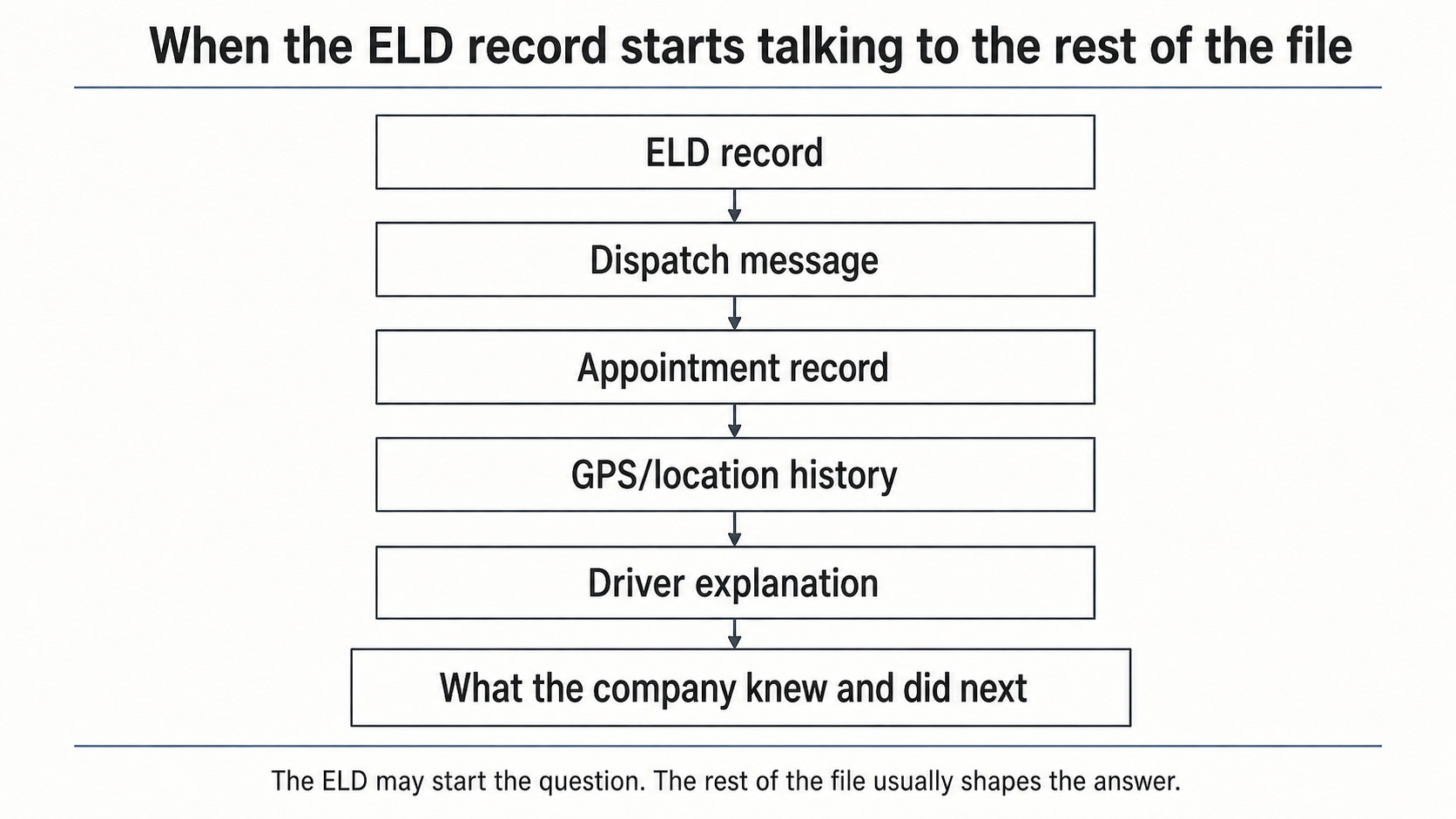
That is usually when weak explanations start sounding weaker.
Unassigned driving time is not just clutter
Unassigned driving time gets treated like a mess somebody has to clean up.
Assign it when it belongs to a driver. Annotate it when it does not. Review it. Retain it. Be able to explain it later.
I get why that feels like dashboard work. There is always another fire somewhere.
But unassigned driving time deserves more respect than that.
It is vehicle movement the company may have to explain later.
Who moved the truck?
Why was nobody logged in?
Was the wrong driver logged into the unit?
Was shop staff moving equipment?
Was the truck being repositioned in the yard?
Was there a malfunction?
Was somebody trying to avoid recorded drive time?
Was this one oddball event, or does the same terminal keep producing the same unexplained movement?
A few short movements may be easy to explain. A pattern is different.
A carrier that treats unassigned driving time only as ELD housekeeping may miss one of the clearest signs that the recorded version of the operation does not match how the operation actually runs.
That matters because outside reviewers do not always see records the same way the company sees them.
Inside the company, people remember the chaos. They remember the driver calling. They remember the truck getting moved to the shop. They remember the customer being late. They remember the dispatcher trying to save the load.
Outside the company, people see records.
They see movement without a driver.
They see vague notes.
They see edits made after the fact.
They see the same problem showing up again.
They see whether the carrier noticed it before somebody else had to ask.
That last part matters.
A bad record is one thing.
A bad record the company saw over and over without doing much about it can become a very different conversation.
Log edits are not suspicious by themselves
A log edit is not automatically a problem.
People make mistakes. A driver selects the wrong status. A system needs a correction. A legitimate edit can make the log more accurate, not less.
But edits need context.
Who made the edit?
Why was it made?
Did the driver confirm or reject it when confirmation was required?
Did the note explain anything?
Did the edit correct a clear mistake, or did it make an ugly day look easier to live with?
One edit may be nothing.
A pattern of edits after late loads, tight appointments, dispatch pressure, or possible violations is worth another look.
There is one thing worth saying plainly here.
Automatically recorded driving time is not something you just make disappear later because the explanation changed. If a driver forgets to select personal conveyance or yard move at the right time, the record still needs to be handled carefully. A good annotation may help explain what happened, but it is not a magic eraser.
And if you have ever worked around ELDs for more than about ten minutes, you know people sometimes want that magic eraser.
The same goes for vague annotations.
“Fixed.”
“Correction.”
“Driver error.”
“PC.”
“Yard move.”
Those notes may have made perfect sense to the person typing them at the time.
Three months later, after a crash, claim, audit, lawsuit, insurance review, or enforcement request, they may not explain much at all.
Nobody needs a novel in the ELD system. That is not what I am saying.
But the note should help a reasonable person understand what happened.
A clear note shows somebody knew what they were looking at.
A vague note can make it look like the company was just trying to get the alert off the screen.
Those are not the same thing.
Look before somebody else does
The mistake is waiting for a serious event to find out what the ELD records have been saying.
By then, the company is not reviewing the records because it is curious.
It is reviewing them because somebody else is asking.
That changes the room.
It changes the tone.
It changes how every vague annotation, repeated violation, ignored alert, and weak corrective action feels.
A carrier does not have to wait for that.
It can pull a recent sample of ELD issues and look for patterns now. Not to prove perfection. Perfect files are rare, and pretending otherwise is a good way to sound ridiculous.
The point is to see whether the same issues keep pointing to the same driver, dispatcher, lane, customer, terminal, unit, shop process, or management decision.
If one driver has repeated problems across every lane, maybe the response needs to be driver-focused.
If several drivers have the same problem on one lane, maybe the lane needs attention.
If personal conveyance keeps showing up after the same customer delays the same loads, maybe the customer conversation is overdue.
If unassigned movement keeps coming from the same yard, maybe the shop or yard process needs work.
If log edits keep appearing after dispatch pressure, then another “driver coached” note may not be much of a fix.
That is where the review has to get honest.
A carrier cannot really say it is managing hours-of-service risk if the log department is the only place hours are being managed.
Dispatch is part of the safety system.
Planning is part of the safety system.
Customer commitments are part of the safety system.
Maintenance movement, yard process, driver training, manager follow-up, and corrective action are all part of the story the records may tell later.
The ELD does not replace judgment.
It gives judgment something to work with.
A system full of alerts that nobody really reviews is not control.
A system that stores violations without follow-up is not control.
A carrier that collects data, sees the same issue repeatedly, and does not change anything may be creating records that show awareness without much action.
That is not a comfortable sentence.
It is still worth taking seriously.
The ELD kept the receipt
The fictional carrier with the repeated personal conveyance issue did not really have an ELD problem.
It had a lane problem.
Or a customer problem.
Or a planning problem.
Maybe all three.
The device did not create the six-hour detention. It did not accept the next load. It did not set the appointment. It did not wait until the driver’s clock was ugly and then ask for another ETA. It did not teach drivers to type vague notes because everyone was too busy to explain the day properly.
The ELD just recorded the movement.
That is why blaming the device is usually the least useful thing a carrier can do.
A better question is not just, “Are the drivers using the ELD correctly?”
A better question is, “What do our ELD records say about how this company actually operates?”
That question is harder.
It may point beyond the driver.
It may point to dispatch.
It may point to a customer.
It may point to a lane everybody complains about but nobody wants to fix.
It may point to weak annotations, lazy corrective action, ignored alerts, or a company that got used to explaining the same problem instead of changing the conditions that keep creating it.
After a crash, claim, audit, lawsuit, enforcement review, or insurance question, the ELD record may not be the whole story.
But it may be where the story starts.
The ELD may be the witness.
The carrier still writes the operational story.
Thanks for reading. Subscribe to Fleet Safety Lane for practical fleet safety breakdowns every Sunday.